Standards & Compliance
The Forge 12 isn't certified because we checked a box. Each standard listed below represents a commitment to building a genuine permanent home — one that can be council approved, insured as residential property, and lived in for generations.
NCC Classification
1A
Permanent Dwelling
The same NCC classification
as the house next door.
Council
Approvable
Property
Insurable
Asset
Appreciating
Rental
Legal
The National Construction Code classifies buildings by their intended use. Class 1A is the classification for a standalone permanent house — a dwelling designed and certified for people to live in on a long-term basis.
Most modular products on the Australian market are not Class 1A. They are registered as caravans, manufactured homes under different legislation, or are unregistered altogether. This creates real problems for buyers: they can't get council approval, they can't insure the structure as property, and they can't legally rent it as a residential dwelling.
The Forge 12 carries NCC Class 1A certification. That's the same classification as the house next door. It means the structure can be lodged for council approval as a secondary or primary dwelling, insured as residential property, legally rented, and — critically — treated by the land market as a permanent asset that contributes to property value rather than depreciating on it.
When we say "permanent home," we're not using a marketing word. We're describing the legal classification.
Full Certification List
Standard
NCC
1A
The National Construction Code classifies the Forge 12 as a Class 1A building — a standalone permanent dwelling. This is the same NCC classification applied to a freestanding house on a traditional slab foundation. It is distinct from Class 1B (rooming houses), Class 4 (caretaker dwellings), or manufactured homes under state legislation.
Class 1A certification means the structure meets the NCC's requirements for structural adequacy, fire resistance, weatherproofing, energy efficiency, and habitability — all independently assessed against the national standard.
Why this matters: Without Class 1A, a structure cannot be approved by most local councils as a dwelling, cannot be insured as residential property, and cannot be legally used or rented as a home. Every caravan and non-compliant "tiny home" falls into this gap. The Forge 12 doesn't.
Standard
AS/NZS
3000
The Forge 12's electrical installation is designed and certified to AS/NZS 3000 — the Australian and New Zealand Wiring Rules. This standard governs the design, installation, and testing of all electrical wiring in buildings intended for human habitation, including circuit protection, earthing, switchboard specification, and cabling requirements.
AS/NZS 3000 compliance is a legal requirement for any residential dwelling in Australia. It cannot be waived, and any electrical work that does not meet this standard is illegal to occupy.
Why this matters: Caravan and non-certified structures frequently operate with sub-standard electrical installations. AS/NZS 3000 compliance means the Forge 12 can be legally connected to grid power, insured without electrical exclusions, and occupied without fire or electrocution risk.
Standard
AS/NZS
3500
All plumbing and drainage in the Forge 12 is installed to AS/NZS 3500, the Australian standard governing cold and hot water systems, sanitary plumbing, and roof drainage. This covers pipe sizing, fixture installation, hot water temperature requirements, and connection to mains water and sewerage.
AS/NZS 3500 compliance is legally required for all permanent residential dwellings in Australia and is a condition of connection to town water and sewerage services in every state and territory.
Why this matters: Non-compliant plumbing creates significant legal liability and insurance risk. AS/NZS 3500 compliance means the Forge 12 can be legally connected to town services, and that all plumbing work is certified by a licensed plumber.
Standard
AS
3740
The bathroom and wet areas in the Forge 12 are waterproofed to AS 3740 — the Australian standard specifying materials, application methods, and performance requirements for waterproofing membranes in wet areas. This covers the shower, bathroom floor, and all wall-to-floor junctions in areas subject to water exposure.
AS 3740 compliance requires inspection and certification by a licensed waterproofer and is a mandatory requirement under NCC Class 1A certification. It cannot be completed by unlicensed labour or skipped in favour of lesser products.
Why this matters: Wet area waterproofing failures are one of the most common and expensive defects in residential construction. AS 3740 compliance means the Forge 12 bathroom is properly protected against water ingress, mould growth, and structural damage — with a certified paper trail.
Standard
BCA
3.7.2
Smoke alarm placement, type, and interconnection in the Forge 12 complies with BCA Section 3.7.2 — the Building Code of Australia's requirements for smoke alarms in Class 1 buildings. This governs the number of alarms, their placement relative to sleeping areas, interconnection requirements, and power supply specifications.
In Queensland, smoke alarm requirements have been progressively strengthened under state legislation, with all dwellings required to meet the latest interconnected photoelectric alarm standard by 2027. The Forge 12 is built to current compliance.
Why this matters: BCA 3.7.2 compliance is a legal requirement for all residential dwellings and a condition of most residential insurance policies. It is not optional, and non-compliance voids insurance coverage in a fire event.
Certification
ENG
CERT
The Forge 12's structural frame is an engineer-certified BlueScope steel system. Certification by a registered structural engineer means the frame has been independently assessed for load-bearing capacity, wind resistance, and structural adequacy under the relevant Australian standards for the building's intended use and location.
BlueScope steel was chosen for its strength, durability, and dimensional stability — a proven structural material engineered to carry load, stand up to Queensland's wind regions, and hold true through transport and decades of service. Unlike timber, a steel frame will not rot, warp, or provide a path for termites.
Why this matters: An engineer certificate is not a manufacturer's claim — it is a legally accountable document produced by a registered professional. It is required for council building approval and for the structure to qualify as NCC Class 1A. It also provides legal protection for the buyer in the event of a structural defect.
Delivery
AUS
WIDE
The Forge 12 is manufactured at our Queensland factory and delivered to sites across Australia. Transport and delivery logistics are managed to protect the structural and finish integrity of the building during transit — the engineer-certified frame is designed to accommodate the loads experienced during transport.
On-site connection to services (water, sewerage, power) is carried out by licensed trades in accordance with the relevant state and territory requirements. We can assist with coordinating licensed trades or work alongside your existing contractors.
Why this matters: A modular home that arrives damaged, out of square, or with compromised finishes is not acceptable. Our delivery process is designed around the same standard of care as the build. Contact us to discuss delivery to your site and any access or site-specific requirements.
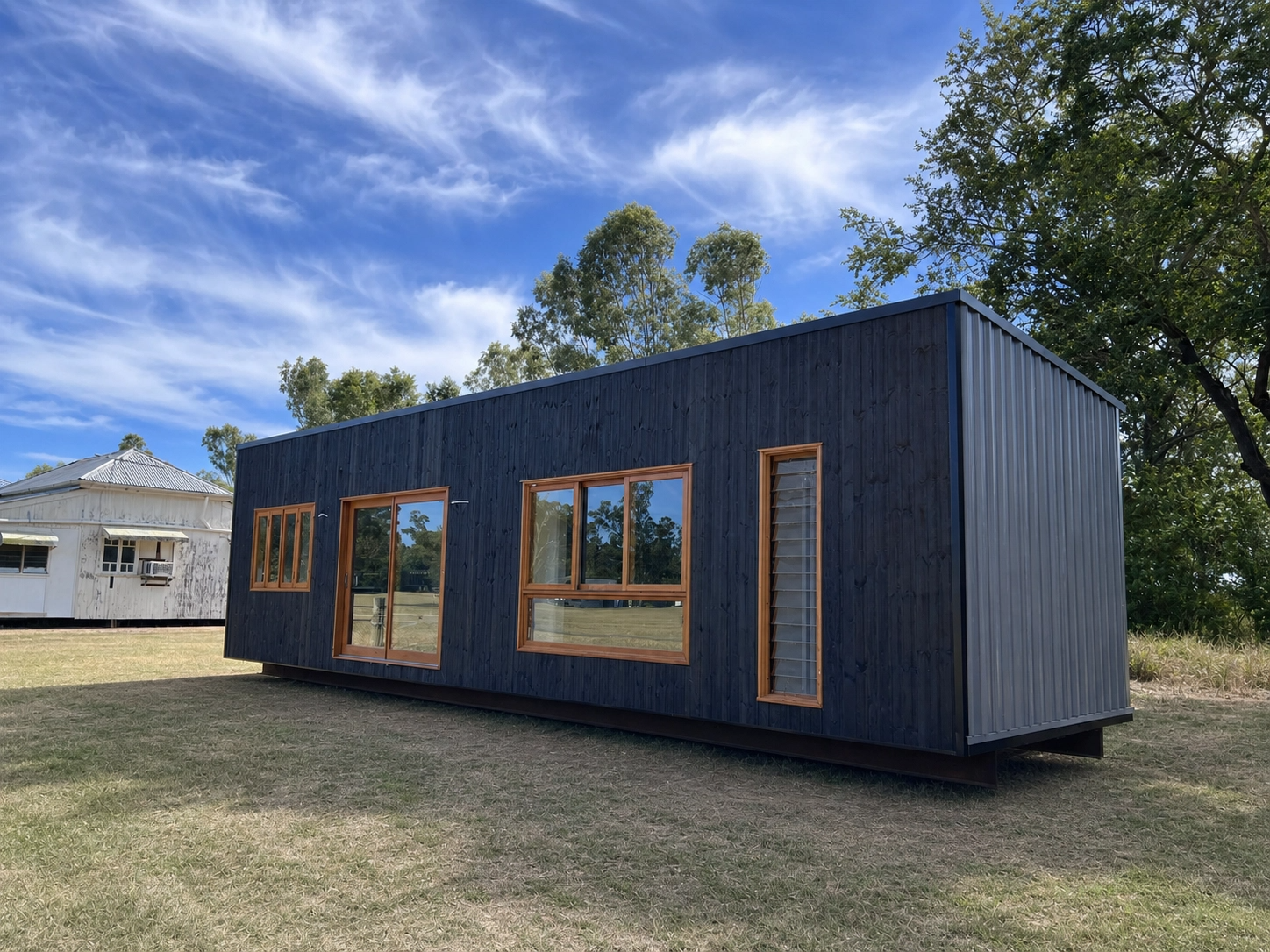
View current project in outer Rockhampton — address by appointment only
The Forge 12 display model in Rockhampton shows the full standard. All certification documentation is available on request.